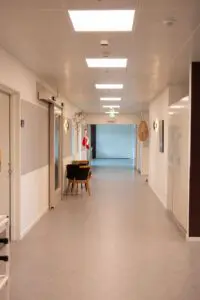



Circadian lighting and amber create a better rehabilitation environment at Hammel Neurocenter Regional Hospital
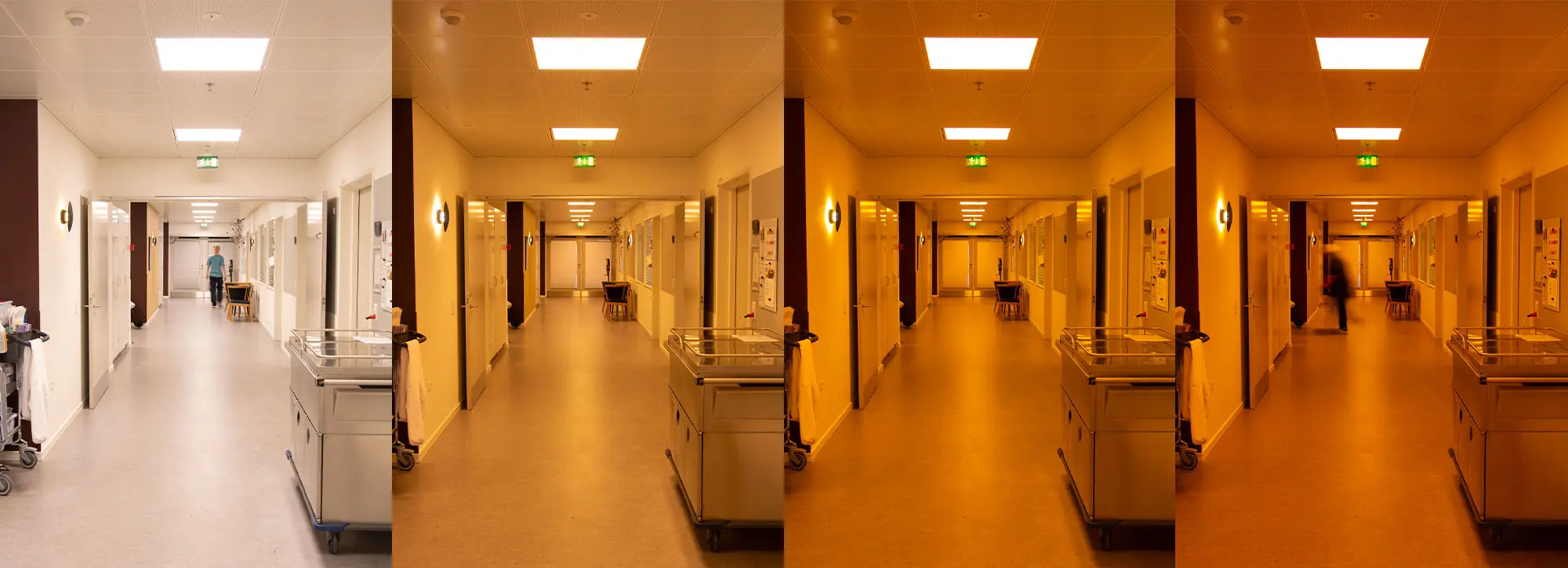
The picture shows how the light changes at Hammel Regional Hospital Hammel Neurocentre from midday to night. The light is customised circadian lighting that recreates the variations in natural daylight and supports the circadian rhythm of patients and staff in the best possible way. Photo: Teamtronic, Nanna Eckhoff
At the Regional Hospital Hammel Neurocentre, where patients with acquired brain injury undergo intensive rehabilitation, light plays an active role in the treatment environment. In collaboration, Teamtronic and MO2 have delivered an advanced lighting solution that combines circadian lighting with specially developed amber technology to support the well-being of both patients and staff.
The benefits of circadian rhythm lighting
Human circadian rhythms are closely linked to the natural alternation between light and dark. When large parts of the day are spent indoors - as is often the case for patients and staff in hospitals - it can disrupt the body's natural rhythms and negatively affect energy, mood and sleep quality.
Customised circadian lighting can recreate the variations in natural daylight to support a stable circadian rhythm. At Hammel Neurocenter, the lighting changes automatically as the day progresses: from warm, gentle lighting in the morning, to bright daylight in the middle of the day, to dim, warm light in the evening and at night. This dynamic contributes to better sleep, increased energy levels for patients and a calmer working environment for staff.
Circadian lighting is controlled via fixed programmes that follow the hours of the day through an astro clock, and is therefore not continuously adjusted according to current daylight. At night, the system automatically ensures low amber lighting in corridors and patient rooms, allowing staff to orientate themselves without unnecessarily disturbing patients' sleep.
Amber - gentle light at night
A first for the hospital, the project utilises Tunable White Amber technology, which makes it possible to use gentle, warm light without blue light content. Amber light, which is in the orange-red spectrum around 590-610 nanometres, is particularly suitable for use at night, where it supports sleep by minimising disturbances - while providing sufficient orientation light for staff.
An important property of amber light is that it has a very low melanopic ratio (Melanopic DER, MDER), which is a measure of the effect of light on the body's circadian rhythm via the biological system. The lower the melanopic, the less the body's biological processes are affected, including the production of the sleep hormone melatonin. This is because light in this part of the spectrum is less likely to activate the special light-sensitive cells in the eye that communicate with the brain's internal clock and regulate the circadian rhythm. That's why amber light is ideal during the night hours to avoid overstimulation and ensure optimal sleep quality - for both patients and staff.
Unlike traditional Tunable White solutions where hot and cold diodes are mixed to create different colour temperatures, the amber diodes in this solution are placed as single chip diodes on PCB board. This technical design provides a cleaner spectral distribution and more controlled amber light quality, which is especially important in sensitive rehabilitation environments like Hammel Neurocentre. It ensures that the light fulfils both visual and biological requirements without overstimulating patients or disrupting their sleep-wake cycle.
Intelligent light control from MO2
MO2 has provided the lighting control and programming of the circadian lighting on the project. All luminaires were supplied by Teamtronic and connected to an intelligent system that enables both automatic circadian lighting and manual selection of different lighting scenarios.
In the staff room, a control panel is installed with access to predefined lighting scenarios such as "Relaxation", "Acute" and "Circadian". The lighting scenarios were developed and programmed by MO2 in close collaboration with the staff at Hammel Neurocenter to ensure that the functionality and lighting environment support both clinical work and patient well-being - while complying with current lighting requirements.
The control panel also provides staff with a clear overview of the lighting status and allows them to quickly and easily control the lighting in all patient rooms, corridors and common areas. Staff can also select lighting scenarios and adjust e.g. brightness via a wall-mounted 4-push button. This gives flexibility to, for example, activate full lighting in emergency situations or customise the light to specific needs.
In the patient rooms, 4-touch lighting with four scenarios has been installed so that patients can control and customise the lighting according to their own wishes and needs.
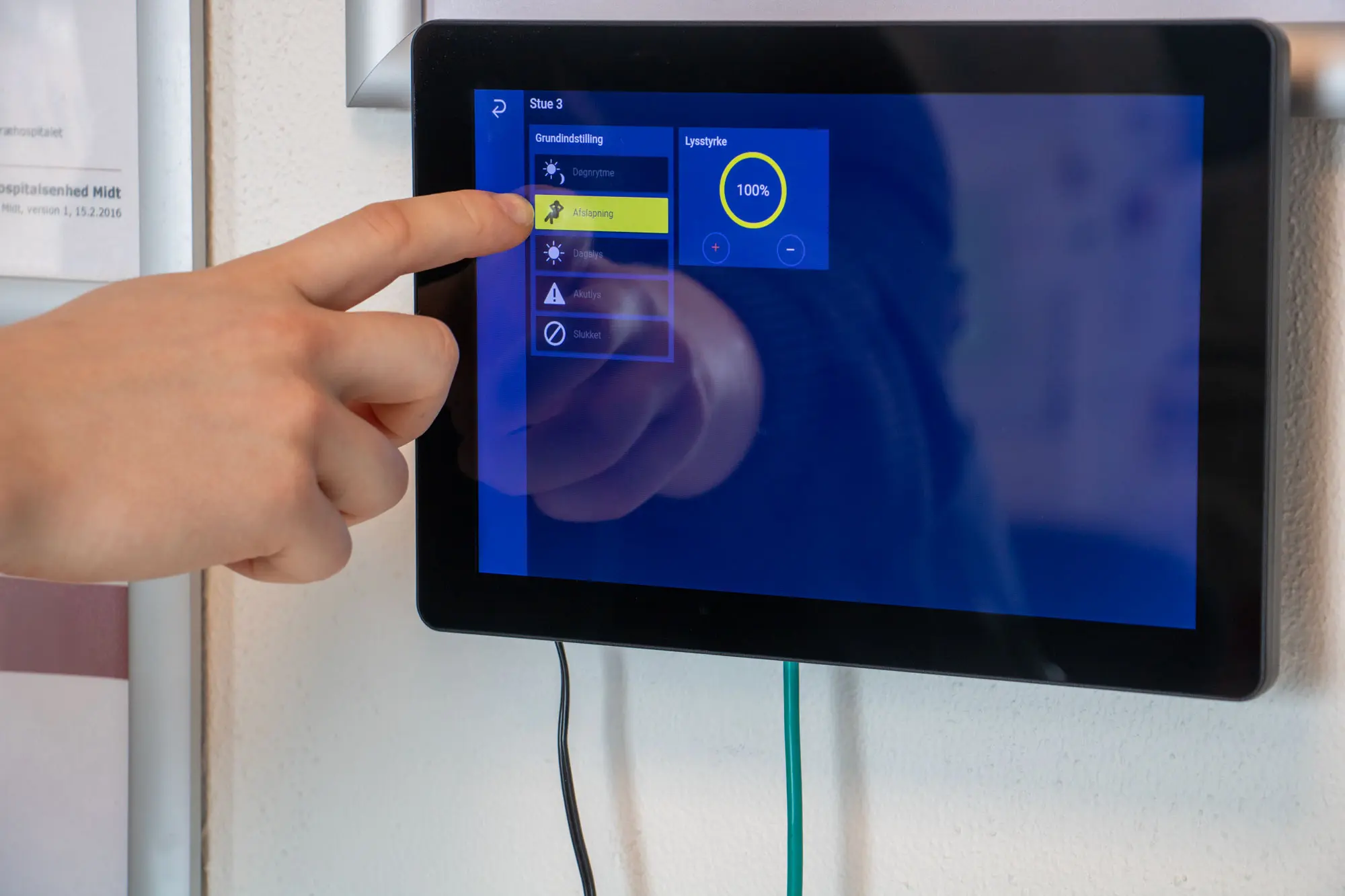
Control panel with access to predefined lighting scenarios. The lighting scenarios were developed and programmed by MO2 in close collaboration with the staff at Hammel Neurocenter. Photo: Teamtronic
Circadian rhythm lighting that supports the healing process
The installation at the Regional Hospital Hammel Neurocentre is an example of how the targeted use of circadian lighting and amber technology can improve rehabilitation environments. Teamtronic's lighting technology solutions combined with MO2's evidence-based control create a framework for increased well-being, better sleep quality and a calmer working environment - for the benefit of both patients and staff.
Read more about Hammel Neurocentre
See reference images and read about our delivery of luminaires to the Regional Hospital Hammel Neurocentre.
Working closely with the project partners, we helped create a well-functioning lighting environment that supports the architectural framework and the daily work at the hospital. Get an insight into the project and see the finished result here.